Oklahoma Telehealth Billing and Policy
Oklahoma telehealth billing and policy covers how telehealth services are defined, delivered, and reimbursed across SoonerCare and private payers. This page outlines key requirements, billing practices, and considerations for providers delivering care in Oklahoma.
Rules and Regulations
Understanding Oklahoma telehealth billing and policy begins with how the state defines telehealth and establishes requirements for service delivery.
Definition & Scope of Telehealth/Telemedicine
“Telehealth” means the practice of health care delivery, diagnosis, consultation, evaluation and treatment, transfer of medical data or exchange of medical education information by means of a two-way, synchronous (real-time) interactive communication, not to exclude store and forward technologies, between a patient and a healthcare provider with access to and reviewing the patient’s relevant clinical information prior to the telemedicine visit.
Any service delivered using telehealth technology must be appropriate for telehealth delivery and be of the same quality and otherwise on par with the same service delivered in person. A telehealth encounter must maintain the confidentiality and security of protected health information in accordance with applicable state and federal law.
Telehealth is considered a mode of service delivery, not a separate category of care, and does not expand covered services beyond those otherwise authorized under Oklahoma law or payer policy.
“Distant site” means the site where the specialty physician/practitioner providing the professional service is located at
the time the service is provided via audio/video telecommunications.
“Originating site” means the location of the SoonerCare member at the time the service is being performed by a
contracted provider via audio/video telecommunications.
Provider Requirements
Clinics offering telehealth services are responsible for ensuring that:
- Providers are appropriately licensed or certified in Oklahoma*
- Services are delivered within the provider’s scope of practice
- Providers are credentialed and privileged to provide telehealth services
- For Medicaid billing, providers are contracted with SoonerCare (Oklahoma Health Care Authority)
Oklahoma does not maintain a separate telehealth license or registration pathway.
*Out-of-state services may be permitted, when medically necessary. Oklahoma issues temporary practice licenses to out-of-state nurses and physicians practicing medicine and surgery.
- The State Board of Osteopathic Examiners has the authority to issue temporary licenses.
- The State of Oklahoma does not allow physical therapists without a valid Oklahoma license to treat Oklahoma residents
- Click here for special details regarding Speech-Language Pathology.
- Click here for special details regarding Optometry.
Telehealth and audio-only health service delivery requires either the provider or the member to be located at the freestanding clinic that is providing services pursuant to 42 Code of Federal Regulations (CFR) § 440.90. Refer to section Oklahoma Administrative Code (OAC) 317:30-3-27 for telehealth policy and OAC 317:30-3-27.1 for audio-only telecommunication policy.
Physician-Patient Relationship
A valid physician-patient relationship may be established via telemedicine under Oklahoma law (Okla. Stat. § 59-478.1), provided that:
- The provider verifies the patient’s identity and physical location
- The provider discloses their name, credentials, and licensure
- The encounter meets the standard of care
- The service is clinically appropriate for telehealth delivery
Historically, Oklahoma has placed limitations on establishing a relationship solely through audio-only encounters, particularly for initial visits and prescribing of controlled substances. Clinics should consult current professional board rules and federal regulations for prescribing nuances and exceptions.
Telehealth must not be used when an in-person examination is required to safely meet the standard of care.
Prescribing & Clinical standards
- Telehealth services must meet the same standard of care as in-person services
- Prescribing decisions must be based on adequate clinical evaluation
- Prescribing based solely on online questionnaires or minimal interaction is prohibited
- Controlled substance prescribing must comply with:
- Oklahoma law
- Federal DEA requirements
- Applicable professional board rules
Clinics should maintain written policies governing telehealth prescribing practices, including escalation to in-person care when appropriate.
Reimbusement
SoonerCare covers eligible telehealth services when they are:
- Medically necessary
- Properly documented
- Delivered by licensed and contracted providers
- Provided using approved telehealth modalities
Telehealth under SoonerCare generally requires interactive, real-time audio-video communication, though audio-only services may be reimbursed when allowed by policy and clinically appropriate.
Oklahoma law requires private health plans to cover telehealth services on at least the same basis as in-person care — insurers may not exclude a service solely because it’s provided via telemedicine if it’s otherwise covered when delivered in person. Cost-sharing (copays/coinsurance/deductibles) for telehealth generally cannot exceed what applies to in-person services.
Consent, Documentation, & Patient Rights
Clinics must ensure that:
- Written patient consent (or their guardian’s consent) is obtained and documented prior to telehealth services
- Consent includes:
- Nature of telehealth
- Technology used
- Limitations and risks
- Privacy protections
- Patients retain the right to withdraw from telehealth services at any time
- They maintain documentation of services, to include: service rendered, location at which service was rendered, and that service was provided via telehealth. (Documentation of services must follow all other SoonerCare documentation guidelines as well.)
Medical records for telehealth encounters must meet Oklahoma documentation and retention standards.
Technology
Telehealth services must comply with:
- HIPAA privacy and security rules
- Oklahoma confidentiality laws
- Secure transmission, storage, and access to PHI
Clinics must ensure:
- HIPAA-compliant platforms
- Staff training on telehealth privacy
- Policies addressing technical failures and data breaches
Billing Policies
Telehealth is treated as a method of delivery, and Oklahoma telehealth billing and policy follows standard coding and reimbursement practices.
SoonerCare (Oklahoma Medicaid)
Covered Services
Telehealth under SoonerCare must be medically necessary and delivered via interactive audio/video or audio-only technology when appropriate; the same coverage limitations and restrictions that apply to in-person services also apply to telehealth.
The following CPT or HCPCS codes- 99421, 99422, 99423, 98970, 98971, 98972 and G2012- are appropriate to report for online digital evaluation and management services when all the requirements are met. Text messaging alone does not meet the requirements of a digital evaluation and management service. Standard evaluation and management service e.g., 99211 or 90832 appended with the GQ modifier should not be billed to indicate the service was rendered by asynchronous telemedicine, when an asynchronous telemedicine code is more appropriate or when all the required elements for those evaluation and management codes are not met.
Audio-only codes must be billed with appropriate CPT codes and modifiers per current CPT/Medicaid guidance (e.g., audio-only E/M codes). Check annual CPT for updates.
Medical codes allowed via telehealth (Updated 7/18/23)
Medical codes allowed via audio-only(Updated 1/30/25)
BH codes allowed via telehealth
BH codes allowed via audio only
Documentation:
Claims should document the service rendered, patient’s location, that the service was provided via telehealth, and meet all usual Medicaid documentation requirements.
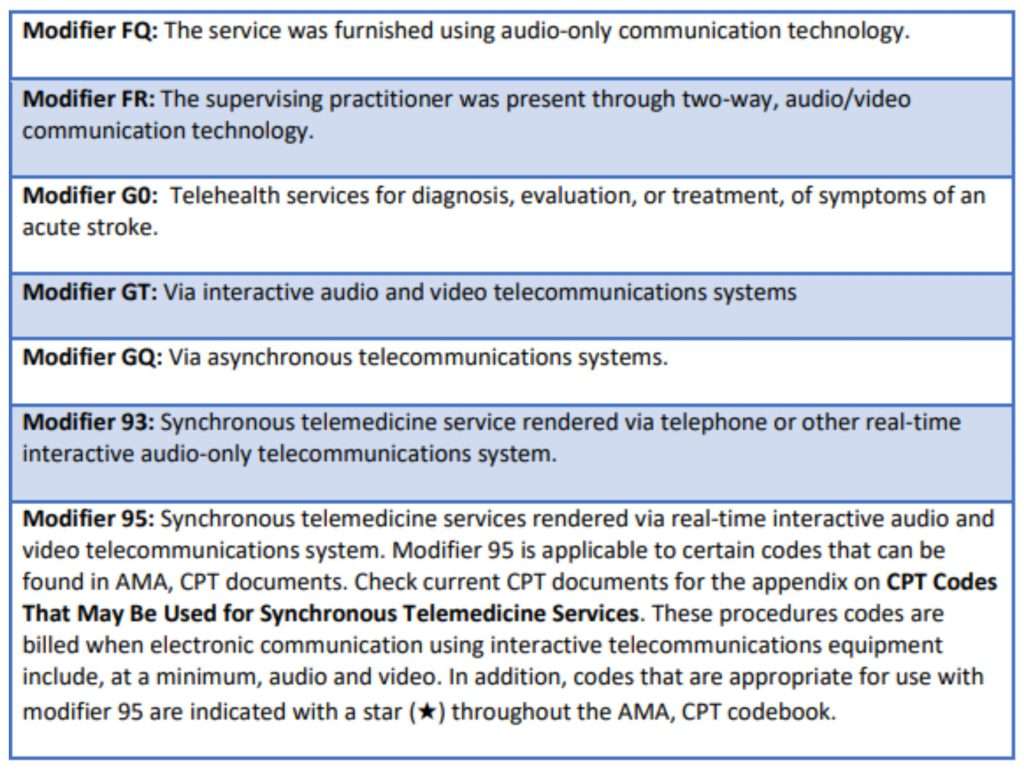
Modifiers FQ, FR, G0, GT, GQ, 93 and 95 are telemedicine service or telehealth service modifiers and must be appended to the HCPCS or CPT code, in conjunction with a place of service (POS) code below, on telehealth or telemedicine claims unless a telemedicine procedure code is billed. Only non- telemedicine procedure codes require the modifier. Additionally, modifier G0 will only be accepted by the Plan when modifier GQ, GT, and/or 95 are appended to the service.
Distant site means a site at which the healthcare provider is located while providing healthcare services by means of telemedicine.
Originating site means a site at which a patient is located at the time healthcare services are provided by means of telemedicine. Authorized originating sites do not currently include a person’s home.
Place of Service (POS) Codes
Telehealth or telemedicine professional claims submitted on a CMS 1500 form must be submitted with POS Code ‘02’or ‘10’. Providers should submit the most appropriate place of service code that accurately describes where the services were rendered. POS 02 does not apply to originating site facilities when billing a facility fee.
- Place of Service (POS) Code 02 (Telehealth Provided Other than in Patient’s Home)
- Place of Service (POS) Code 10 (Telehealth Provided in Patient’s Home):
HCPCS Q3014 “Telehealth originating site facility fee”:
- The provider who is supplying the room and telecommunication equipment with the member physically present, may submit Q3014.
- The member visits their PCP’s office, and the PCP helps to initiate a telehealth appointment with a specialist located in another office location.
- PCP’s office can submit Q3014 for physically hosting the patient (member). The specialist located in another office location may not bill code Q3014 since they are not the originating site.
Inappropriate billing of Q3014 (Not to be used for virtual type visits or use of equipment for those purposes):
- The member is in their home and initiates telehealth visit with their PCP.
- Since the PCP is not physically hosting the patient (member), they cannot bill Q3014 as the patient (member) is not present at their facility.
- The PCP is acting as a distant site provider to the member who is at home.
Telehealth Origination Site Fee, Effective date: February 1, 2026
The revisions amend the Medicaid State Plan to add a reimbursable originating site (facility) fee for telehealth services. This change allows certain facilities hosting a member during a telehealth visit to receive separate reimbursement when the appropriate facility-fee code is billed. Eligible originating sites include hospitals, outpatient departments, physician and practitioner offices, Rural Health Clinics (RHCs), Federally Qualified Health Centers (FQHCs), Indian Health/Tribal/Urban (I/T/U) clinics, and public health clinics. This fee is reimbursed separately from the professional service billed by the distant-site provider and does not apply when the member’s home is the originating site or when no staff or facility resources are used. Equipment and transmission costs remain non-reimbursable.
Removal of Physician Visit Limits, Effective date: February 1, 2026.
The proposed revisions remove existing caps on adult physician visits, including the four-visit monthly limit and the two-visit limit for members residing in nursing facilities. Removing these limits allows members to receive all medically necessary outpatient services and supports timely access to primary and preventive care.
Reimbursement
- Health care services delivered by telehealth such as Remote Patient Monitoring, Store and Forward, or any other telehealth technology, must meet OHCA standards in order to be reimbursed. See Oklahoma Care Authority- Telehealth.
- Services provided by telehealth must be billed with the appropriate modifier.
- If the technical component of an X-ray, ultrasound or electrocardiogram is performed during a telehealth transmission, the technical component can be billed by the provider that provided that service. The professional component of the procedure and the appropriate visit code should be billed by the provider that rendered that service.
- The cost of telehealth equipment and transmission is not reimbursable by SoonerCare.
- For reimbursement of audio-only health service delivery, see OAC 317:30-3-27.1.
Private Payers — Telehealth Coverage & Payment Parity
Oklahoma law requires private health plans to cover telehealth services on at least the same basis as in-person care — insurers may not exclude a service solely because it’s provided via telemedicine if it’s otherwise covered when delivered in person. Cost-sharing (copays/coinsurance/deductibles) for telehealth generally cannot exceed what applies to in-person services.
Additional Requirements for School Settings
Please note that in order for school-based telehealth to be reimbursed by SoonerCare, the services must meet a special set of requirements, in addition to the initial requirements set by OHCA.
Consent- Advance parent or legal guardian consent for telehealth services must be obtained for minors
Notification- For telehealth medical services provided in a primary or secondary school setting, the telehealth practitioner must provide a summary of the service, including, but not limited to, information regarding the exam findings, prescribed or administered medications, and patient instructions, to
(A) The SoonerCare member, if he or she is an adult, or the member’s parent or legal guardian, if the member is a minor; or
(B) The SoonerCare member’s primary care provider, if requested by the member or the member’s parent or legal guardian.
Quick Billing Summary (Oklahoma)
Scenario: Telehealth office visit for a SoonerCare member
✔ Bill standard CPT/HCPCS code for the service.
✔ Include appropriate telehealth modifier (e.g., GT or 95).
✔ Use proper Place of Service (POS).
✔ Add originating site fee (Q3014) if valid and applicable.
✔ Submit via SoonerCare or managed provider billing portal and follow OHCA provider manual instructions.
Notes & Best Practices
- Always verify with the specific SoonerCare provider manual and managed care plan instructions as policies and reimbursable telehealth code lists are updated regularly. General Telehealth Guidance
- Check for audio-only service lists and updated telehealth CPT guidance each year. Audio-only guidance
- Private payer contracts may have additional billing requirements that differ from state-mandated parity language, so review contracts and insurer policies.
Checklist for a Primary Care Clinic
Understanding Oklahoma telehealth billing and policy helps ensure services are delivered and billed appropriately.
To implement telehealth in Oklahoma lawfully, your clinic should ensure:
- Licensure Compliance
- All providers are licensed in Oklahoma or have appropriate telehealth waivers/licensure via compact.
- Telehealth Policy & Consent
- Written telehealth policies, patient consent procedures, and documentation practices are established.
- Clinical Standards
- Telehealth services follow the same standards as in-person care, including reporting and follow-up protocols.
- Technology & Privacy
- Only HIPAA-compliant platforms for video visits. List of Telehealth Platforms
- Billing & Reimbursement
- Proper coding, payer requirements understood (e.g., Medicaid, private insurance). Telehealth Certification Institute
- Prescribing Requirements
Policies for telemedicine prescribing align with state board rules.
References
Policies & Billing
- Telehealth Bill 317 Title 317, Oklahoma Health Care Authority
- Oklahoma Telehealth. CCHP
- Federal Regulations. HRSA
- Medicare Billing and Coding
- 2024 Oklahoma Statutes Title 59. Professions and Occupations §59-478.1. Establishment of physician-patient relationship through telemedicine. Justia
- Legal Requirements for Telehealth Services. American Academy of Family Physicians
- CCHP Fact Sheet- Oklahoma Policies at a Glance
Data:
- Oklahoma Physician Shortage Facts- The Cicero Institute
- Cherokee Nation Telemedicine Report
- Oklahoma’s telehealth landscape: How policy is expanding access to care in Oklahoma. Healthy Minds Policy Initiative
- CDC Telehealth Data
For more information:
- American Health Association- Telehealth
- Oklahoma provider certification. Telehealth Certification Institute
- Oklahoma Hospital Association- Telehealth
- Telehealth Overview- Oklahoma Health Care Authority.
- Oklahoma Office of Telehealth
- Chicksaw Nation Virtual Medicine Visit
Providers should stay current with Oklahoma telehealth billing and policy as payer rules and coverage evolve.